

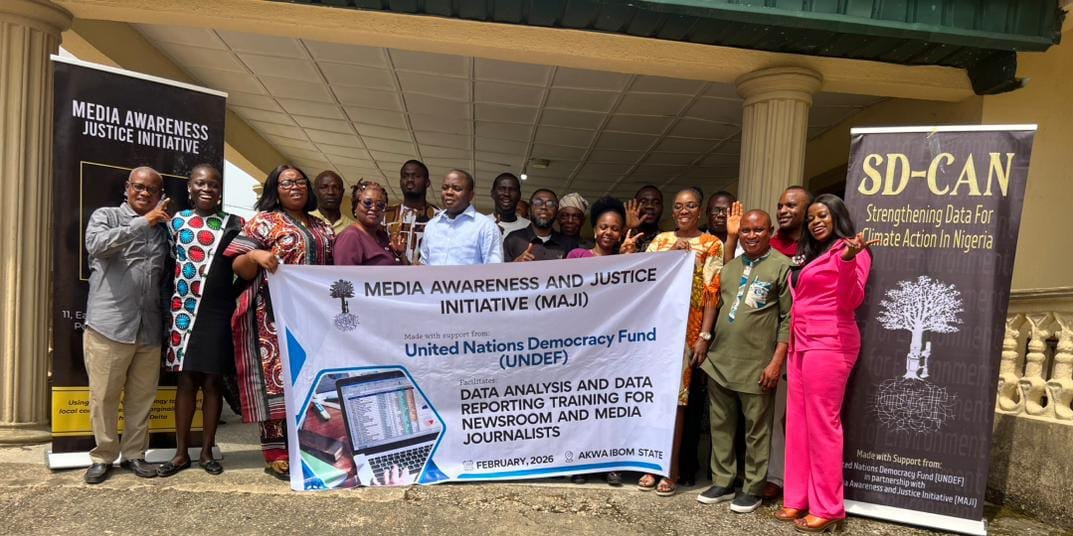
No fewer than 20 journalists in Akwa Ibom State have been trained on the use of scientific data and emerging technologies to enhance environmental reporting, as part of efforts to promote evidence-based journalism in the Niger Delta.
The capacity-building workshop, organised by the Media Awareness and Justice Initiative (MAJI), was held on February 26, at the Nigeria Union of Journalists (NUJ) Secretariat in Uyo, Akwa Ibom State capital.
The one-day training tagged, “Environmental Data Collection for Evidence-Based Journalism,” was supported by the United Nations Democracy Fund (UNDEF).
Presenting the lecture, the Environment and Conservation Officer of MAJI, Ikechukwu Ahaka, raised concerns over the limited access to credible environmental data, describing it as a major obstacle to effective journalism and public accountability in the region.
According to him, the persistent disconnect between scientific findings and media reporting has weakened citizen engagement and slowed policy responses to pressing environmental challenges across the Niger Delta.
According to him, “Environmental stories should be driven by identified data insights that will promote participatory citizens’ action in a constructive manner” emphasising that, empowering journalists with the skills to interpret and utilise scientific data is essential to improving transparency, influencing policy decisions, and amplifying community concerns.
The training, which earlier held in Bayelsa State is expected to be extended to Rivers State after Akwa Ibom State, with a focus on deepening investigative reporting through participatory technologies and evidence-based storytelling.
Participants were exposed to practical data collection tools, including sensor-based monitoring systems, field sampling techniques, low-cost Internet of Things (IoT) devices, satellite imagery, and mobile data applications.
Beyond the technical sessions, participants identified systemic challenges such as; government restrictions, inaccessibility of public data, and safety risks during field investigations as critical policy gaps that require urgent attention.
Ahaka maintained that, strengthening institutional collaboration, promoting Open Data Systems, and encouraging community-based environmental monitoring would significantly improve reporting outcomes.
In another presentation, facilitator and lecturer, Prince Eze, underscored the importance of grounding advocacy in credible and verifiable data.
“Advocacy is a structured process aimed at drawing attention to specific issues and guiding policy makers toward practical solutions,” warning that weak data systems often result in flawed decisions making.
Dr. Eze, urged journalists to adopt a strategic and evidence-based approach to reporting, especially when engaging stakeholders and shaping public discourse.
The workshop concluded with a hands-on session on data analysis, where participants received practical training in data cleaning, organisation, visualisation, and interpretation to enhance impactful environmental storytelling.
Many of the journalists described the programme as timely and transformative, expressing confidence that the knowledge acquired would significantly improve the quality and depth of environmental reporting in Akwa Ibom State and beyond.