
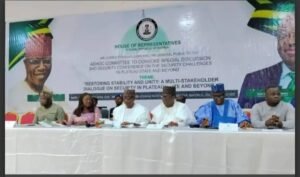
Lawmakers in the House of Representatives, alongside key stakeholders, have called for sweeping legislative and structural reforms to stem the tide of persistent violence in Plateau State and across Nigeria’s Middle Belt.
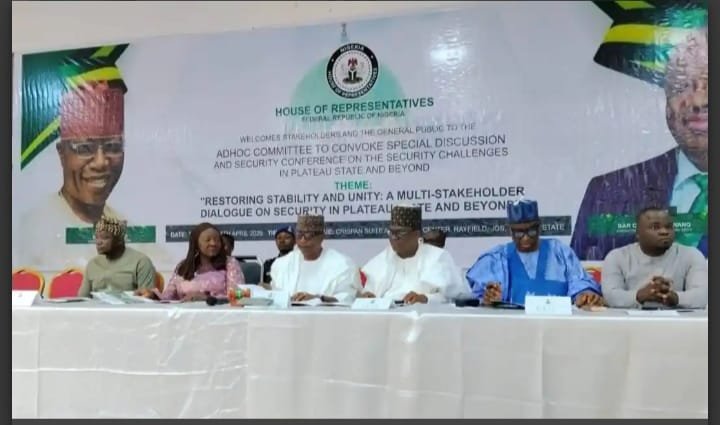
The call was made at a high-level security conference held Tuesday in Jos, organised by the House of Representatives Ad-Hoc Committee on Security Challenges in Plateau State and Beyond.
The gathering convened traditional rulers, religious leaders, security agencies, civil society groups, and victims under the theme: “Restoring Stability and Unity: A Multi-Stakeholder Special Dialogue on Security in Plateau State and Beyond.”
Declaring the conference open, Plateau State Governor, Caleb Mutfwang, described the dialogue as both timely and imperative, stressing that the insecurity in Plateau mirrors a wider national crisis that demands coordinated legislative and executive action.
Represented by his deputy, Josephine Piyo, the governor acknowledged that successive administrations have struggled to break the cycle of violence despite sustained interventions.
He outlined steps taken by his government to strengthen security, including the revitalisation of Operation Rainbow, recruitment of additional personnel, and the establishment of a Plateau Activity Centre equipped with drone surveillance technology to enhance coordinated operations.
Mutfwang further disclosed that over 300 operational vehicles belonging to security agencies have been refurbished, while motorcycles have been procured to improve rapid response, particularly in rural and hard-to-reach communities.
He emphasised that security goes beyond the deployment of forces, noting that justice, inclusion, economic opportunities, and public trust are essential pillars for lasting peace. To this end, he said the state has reconstituted the Inter-Faith Advisory Council to promote dialogue, reconciliation, and mutual understanding among diverse groups.
In his remarks, Speaker of the House of Representatives, Abbas Tajudeen, represented by Hon. John Dafaan, described the conference as a decisive legislative intervention aimed at confronting insecurity head-on.
He reaffirmed the National Assembly’s commitment to reforms that would halt further loss of lives, highlighting key priorities such as strengthening intelligence and early warning systems, reforming land governance, promoting inclusive peacebuilding platforms, and deepening community policing.
Dafaan also reiterated legislative support for President Bola Ahmed Tinubu’s push for the establishment of state police, while advocating the empowerment of vigilante groups and traditional institutions within a legal framework.
Chairman of the Ad-Hoc Committee, Hon. Wale Hammed, assured participants that insights from the conference would be translated into concrete legislative action.
He stressed that sustainable peace cannot be achieved through force alone but must be anchored on inclusion, dialogue, and trust.
Hammed added that the committee created room for closed-door sessions to enable victims and stakeholders share candid and sensitive testimonies.
On the sidelines of the event, the Executive Chairman of Mangu Local Government Council, Hon. Emmanuel Bala Molpun, underscored the critical role of robust legal frameworks in resolving the crisis.
He argued that Nigeria’s security challenges—particularly in Plateau and the Middle Belt—can be significantly reduced through effective legislation backed by strict enforcement.
“The strength of any democracy lies in the rule of law. Where there are clear laws and the political will to enforce them, insecurity can be drastically reduced,” he stated.
Molpun called for urgent legislation to regulate grazing and livestock management, linking the recurring conflicts to unregulated pastoral movements exacerbated by environmental pressures such as desertification.
“Without clear laws governing grazing and livestock movement, criminal elements will continue to exploit the system,” he warned, urging decisive action to prevent further deterioration of security.
Participants at the conference echoed similar concerns, identifying intelligence sharing, community-based policing, land reforms, and technology-driven early warning systems as critical pathways to achieving lasting peace.
The Ad-Hoc Committee disclosed that findings from its consultations across conflict-prone areas in Plateau State would shape comprehensive legislative proposals aimed at addressing the root causes of violence and preventing further bloodshed in the state and beyond.