
By IKPAT UduakAbasi
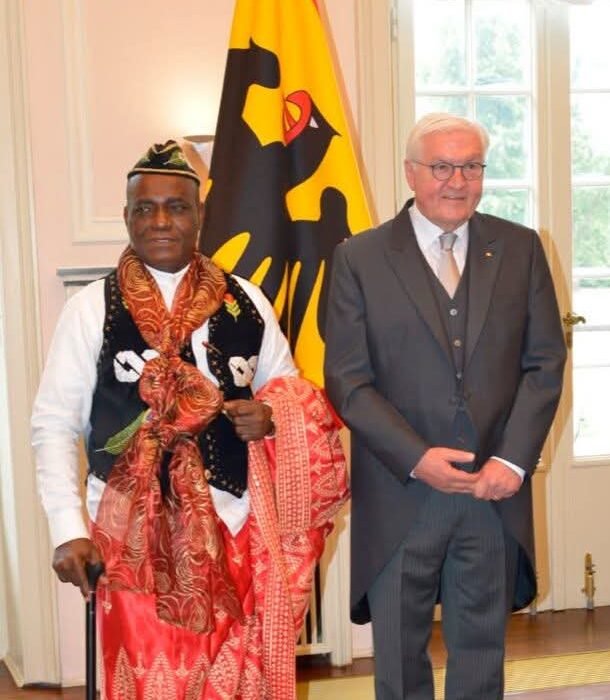
As one of Nigeria’s most prominent political figures, Senator Ambassador Ita Solomon Enang, OFR, NPOM, has consistently demonstrated that cultural identity is not a burden in diplomacy but an asset. His audience with German President Frank-Walter Steinmeier in Berlin, the capital of Europe’s largest economy, reflected more than the presentation of diplomatic credentials, it projected the pride, dignity and enduring heritage of the Ibibio people onto one of the world’s most influential diplomatic stages.
As the Chinese philosopher Confucius observed, “The strength of a nation derives from the integrity of the home.” Nations that confidently project their cultural identity often command greater respect in the international community.
Enang’s appearance at Bellevue Palace therefore transcended protocol. While the presentation of Letters of Credence formally inaugurated his tenure as Nigeria’s Ambassador Extraordinary and Plenipotentiary to Germany, it also demonstrated that effective diplomacy can successfully blend national responsibility with cultural authenticity.
By proudly identifying with his roots, he reinforced the truth that a diplomat best represents his country when he remains connected to the values and traditions that shaped him. This cultural confidence carries profound significance in an era where nations increasingly deploy soft power to strengthen their presence.
Beyond economic statistics and political influence, the character, traditions and identity of a people often become enduring symbols of national prestige. Ambassador Enang’s projection of Ibibio heritage contributed to that broader narrative by presenting Nigeria as a country whose diversity enriches rather than weakens its global identity.
The symbolism of the visit became even more compelling because it unfolded in Berlin, Germany, the Europe’s largest economy and one of Nigeria’s most strategic development partners.
Standing before one of the continent’s most vibrant and influential leaders while visibly embracing his cultural heritage conveyed a subtle and powerful message that Nigeria’s ethnic diversity remains one of its greatest diplomatic strengths rather than a point of division to the people.
Yet cultural symbolism alone was not the defining outcome of the engagement. The bilateral discussions between both leaders addressed critical areas capable of shaping the future of Nigeria-Germany relations, including trade, investment, energy cooperation, agriculture, power infrastructure, technology transfer and skills development. The meeting reflected a shared determination to deepen mutually beneficial partnerships beyond traditional diplomatic exchanges.
Particularly noteworthy on this historic occasion was the commitment to advance a proposed Nigeria-Germany Migration Agreement designed to establish structured pathways for qualified Nigerian professionals in healthcare, engineering, artificial intelligence and technology to contribute to Germany’s workforce. Such collaboration demonstrates that contemporary diplomacy is increasingly measured by opportunities it creates for citizens rather than ceremonial exchanges alone.
The conversations between both leaders highlighted prospects for an increased German investment in manufacturing, automobile assembly, renewable energy and industrial development. Of particular importance is the very emphasis on gas utilisation projects capable of converting flared gas into electricity, a development that perfectly aligns with Nigeria’s aspirations for sustainable energy, industrial growth and economic diversification in years ahead.
Regional peace and security however also featured very prominently during the engagement, reflecting Nigeria’s strategic position within West Africa. Discussions on ECOWAS, renewed engagement with Sahelian states and notable humanitarian concerns surrounding Bakassi Peninsula illustrated that Enang’s assignment extends beyond bilateral cooperation to include issues affecting regional stability and Africa’s collective development.
Equally significant was Ambassador Enang’s articulation of his vision to serve as “a bridge of prosperity” between Nigeria and Germany. That commitment reflects the evolving philosophy of Nigeria’s foreign policy, where economic diplomacy, investment promotion, technology acquisition and diaspora engagement increasingly define the success of diplomatic missions.
His interaction with Nigerians resident in the Federal Republic of Germany further reinforced this people-centred approach. By assuring the diaspora of an open-door policy and committing the embassy to addressing concerns relating to consular services, education and professional recognition, he affirmed that diplomacy must remain responsive to the welfare of citizens beyond national borders.
For the people of Akwa Ibom State, and indeed the wider Ibibio nation, Ambassador Ita Enang’s emergence on such a distinguished international platform inspires renewed confidence in the global relevance of indigenous identity. It demonstrates that cultural heritage is not diminished by international exposure; rather, it gains greater visibility and appreciation when presented with dignity, confidence and purpose.
Ultimately, Ambassador Ita Enang’s assumption of office in Berlin should be remembered not only as a diplomatic milestone but also as an affirmation that authentic representation begins with embracing one’s roots. By projecting Ibibio heritage while advancing Nigeria’s strategic interests in Europe’s largest economy, he offered a compelling reminder that culture and diplomacy are complementary instruments of national influence. In doing so, he strengthened Nigeria’s image abroad while proving that local identity, when confidently expressed, can become a powerful language of global engagement.
Ambassador Ita Enang And The Global Projection Of Ibibio Heritage