

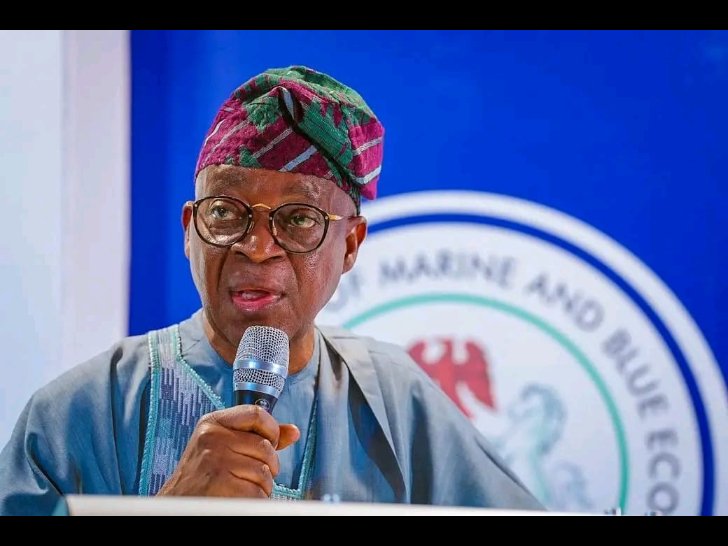
The Federal Government has announced far-reaching plans to expand seafarer training, professional certification and onboard practical experience in order to improve the competitiveness of Nigerian maritime professionals in the international shipping industry.
The government said the initiative is aimed at repositioning Nigeria’s maritime workforce to meet international standards and to enable Nigerian seafarers compete favourably with their counterparts across the world.
The Minister of Marine and Blue Economy, Mr. Adegboyega Oyetola, disclosed this at the 2026 World Maritime Day celebration held in Lagos, where stakeholders in the maritime industry gathered to deliberate on the future of the sector.
Oyetola, while delivering his keynote address at the event, stressed the critical importance of skilled manpower to the growth, development and sustainability of Nigeria’s maritime sector.
According to him, no nation can achieve meaningful development in its maritime industry without investing heavily in human capacity, particularly in the training and retraining of seafarers who are the backbone of shipping operations.
The Minister noted that Nigeria, with its vast coastline, large population and strategic location along the Gulf of Guinea, has huge potential to become a major hub for maritime services, but this potential can only be realised with a well-trained workforce.
He explained that the Federal Government is already expanding training opportunities for young Nigerians who wish to build careers at sea, through partnerships with key industry stakeholders and established maritime institutions.
Oyetola said the government is working closely with organisations such as the Nigeria LNG Limited and the Maritime Academy of Nigeria, Oron, to provide cadets with the practical sea-time experience required for professional certification.
He said many Nigerian cadets graduate from maritime institutions without the mandatory onboard experience needed to obtain their Certificate of Competency, a situation which has limited their chances of securing jobs in international shipping companies.
To address this challenge, the Minister revealed that the government has facilitated arrangements with shipping companies and industry players to create more berths for Nigerian cadets to enable them acquire the required sea-time experience.
He added that the Ministry of Marine and Blue Economy is also working to ensure that the curriculum and training facilities at the Maritime Academy of Nigeria, Oron, and other accredited institutions are upgraded to meet global standards.
Oyetola further stated that the government is reviewing the processes for professional certification to make it more efficient, transparent and aligned with the requirements of the International Maritime Organisation, IMO.
According to him, the goal is to ensure that certificates obtained in Nigeria are respected and recognised internationally, thereby opening more doors for Nigerian seafarers in the global labour market.
The Minister also used the occasion to highlight other ongoing reforms in the maritime sector aimed at improving trade, creating employment opportunities and enhancing national development.
He said the Federal Government is investing heavily in the modernisation of the nation’s ports to make them more efficient, competitive and attractive to both local and international shipping lines.
Oyetola explained that port modernisation efforts include the deployment of modern cargo handling equipment, digitisation of port operations and improvement of access roads to reduce congestion and delays.
He added that the government is strengthening maritime security through collaboration with the Nigerian Navy, NIMASA and other security agencies to curb piracy, sea robbery and other criminal activities on Nigerian waters.
According to him, improved security in the maritime domain will not only boost confidence among ship owners but will also increase vessel traffic to Nigerian ports and enhance revenue generation.
The Minister further disclosed that the government is developing the fisheries and aquaculture sub-sector to improve trade, create jobs for the teeming youth population and enhance national food security.
He noted that Nigeria spends huge amounts of foreign exchange on fish importation, and that developing local capacity in fisheries will help reduce this dependence and create wealth for coastal communities.
Oyetola assured stakeholders that the Federal Government remains committed to providing the enabling environment for private sector investment to thrive in the maritime industry.
He called on ship owners, terminal operators, training institutions and other stakeholders to support the government’s efforts by investing in human capacity development and adhering to international best practices.
The 2026 World Maritime Day celebration, which was attended by maritime professionals, cadets, ship owners and representatives of international organisations, ended with a call for concerted efforts to reposition Nigeria’s maritime sector for greater competitiveness on the global stage.