
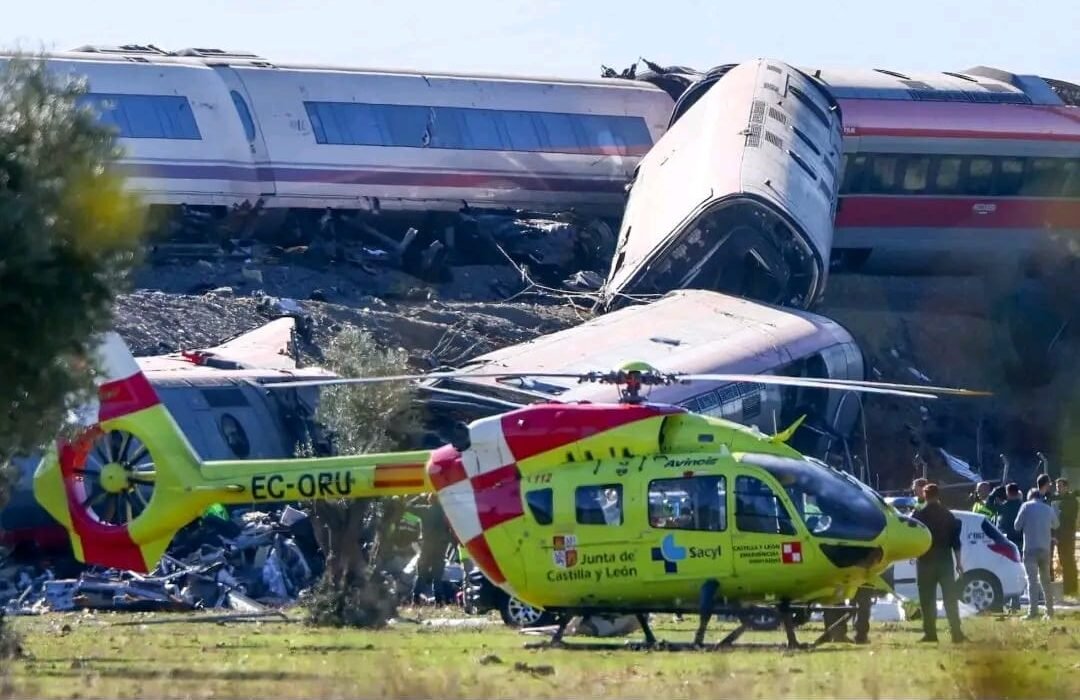
At least 68 persons have been confirmed dead following a catastrophic collision involving two high-speed trains in Spain on Wednesday, in what has become the country’s worst rail accident in over a decade and Europe’s deadliest train disaster since 2013.
The tragic incident, which occurred south of Madrid, has thrown the entire Spanish nation into mourning, with emergency workers still combing through the mangled wreckage in search of more bodies and survivors trapped beneath twisted metal.
The collision, which involved two trains operated by Renfe, Spain’s state-owned rail company, happened on Wednesday, October 28, near the town of Urda in the central region of the country, according to reports from international news agency, Reuters.
Authorities in Spain said the death toll, which currently stands at 68, is expected to rise further as rescue operations continue and many of the injured are said to be in critical condition in various hospitals where they were rushed to for treatment.
The Spanish Minister of Transportation disclosed that preliminary investigation showed that one of the Renfe trains involved in the accident was authorised to continue its journey despite the presence of an active red signal indicating danger ahead.
He explained that the red signal was active because there was a stationary train ahead on the same track, raising serious questions about why the moving train was given clearance to proceed into an occupied section of the railway line.
According to the Minister, the moving train was allowed to proceed under a special authorisation procedure, a practice that is sometimes used when there are signalling issues, but which requires extreme caution and strict compliance with safety protocols.
He noted that the circumstances surrounding the authorisation are now the subject of an urgent and thorough investigation by rail safety authorities, the Ministry of Transport and the judicial authorities in Spain.
Eyewitnesses and survivors described scenes of horror, chaos and confusion, as the impact of the collision caused several coaches to derail, overturn and crumple, trapping passengers inside and flinging others out of the wreckage.
Emergency services, including firefighters, paramedics, police and civil protection operatives, were immediately deployed to the scene, where they worked for several hours under difficult conditions to rescue survivors and recover bodies from the debris.
The Spanish Prime Minister has expressed deep shock and condolences to the families of those who lost their lives, describing the accident as a national tragedy and declaring that the government will ensure a transparent and comprehensive investigation is carried out.
He also announced that the Spanish government will observe a period of national mourning in honour of the victims, while flags will be flown at half-mast across all public buildings and institutions throughout the country.
Spain’s King Felipe VI also issued a statement sympathising with the bereaved families and commending the efforts of rescue workers who have been working tirelessly since the accident occurred to save lives.
Medical authorities in the Castilla-La Mancha region, where the accident occurred, said hospitals in Toledo, Ciudad Real and Madrid have been placed on high alert and have received dozens of injured passengers with varying degrees of injuries.
Some of the injured victims were said to have sustained severe fractures, head injuries, internal bleeding and burns, with doctors battling to stabilise those in critical condition and prevent further loss of lives.
The rail route where the accident happened is one of Spain’s busiest high-speed corridors, connecting Madrid to Andalusia in the south, and is regularly used by thousands of commuters, business travellers and tourists on a daily basis.
Following the accident, Renfe announced the immediate suspension of all high-speed services on the affected line, while alternative arrangements are being made to transport stranded passengers and to conduct safety checks on the entire network.
This latest accident marks the second deadly rail crash in Spain this year, raising renewed concerns about railway safety standards, maintenance culture and operational protocols in the European country’s otherwise modern rail system.
It also represents the deadliest train accident in Europe since 2013, when a high-speed train derailed in Santiago de Compostela in north-west Spain, killing 79 people and injuring over 140 others.
That 2013 disaster, which was attributed to overspeeding, had prompted far-reaching reforms in Spain’s rail safety regulations, including the installation of more advanced automatic braking systems across the high-speed network.
Transport unions and rail safety experts in Spain have already begun calling for an independent and thorough probe into Wednesday’s collision, insisting that those found culpable must be held accountable to prevent future occurrences.
Some union leaders have questioned the decision to authorise a train to pass a red signal when another train was stationary ahead, describing it as a serious breach of standard safety procedures that should never have been allowed.
The European Railway Agency has also indicated that it will be monitoring the investigation closely, given the magnitude of the accident and its implications for rail safety standards across the European Union.
Families of victims have been gathering at hospitals, mortuaries and at the accident site, anxiously waiting for information about their loved ones, with many of them expressing anguish, disbelief and frustration over the slow process of identification.
The Spanish government has set up emergency information centres and helplines to provide support, counselling and updates to relatives of passengers who were on board the two trains at the time of the collision.
International condolences have continued to pour in from leaders across Europe and beyond, with the European Commission, French President, German Chancellor and other world leaders sending messages of solidarity to Spain.
Meanwhile, forensic experts and accident investigators have cordoned off the entire accident site to preserve evidence, recover the black boxes of both trains and reconstruct the sequence of events that led to the collision.
Officials say it may take several days or weeks to fully determine the exact cause of the accident, as they will need to analyse data from the signalling system, the trains’ recording devices and testimonies from survivors and rail workers.
As at the time of filing this report, heavy duty cranes and earth moving equipment had been deployed to the scene to lift the wrecked coaches and enable rescuers to access areas that were previously unreachable.
The Spanish Minister of Transportation has assured Nigerians and the international community that the government will make public the findings of the investigation and will implement any recommendations to improve safety on the country’s high-speed rail network.