
 The Akwa Ibom State Government has firmly rejected reports suggesting that, some of its oil wells may be “returned” to Cross River State, describing the claims as speculative, misleading and constitutionally impossible.
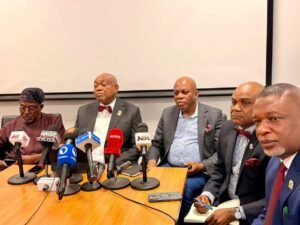
Speaking at a press briefing in Uyo, the Attorney-General and Commissioner for Justice, Mr. Uko Udom, SAN, said what was submitted on February 13, 2026, to the Revenue Mobilisation Allocation and Fiscal Commission (RMAFC) by a Federal Government inter-agency committee was only a draft document and not a final decision or recommendation.
Udom explained that, RMAFC itself had publicly clarified that the document did not represent any concluded position and had not resulted in any reallocation of oil wells.
He said media reports portraying the document as a binding decision were premature and deliberately distorted.
Beyond the procedural issues, the Attorney-General stressed that the matter had already been conclusively settled by the Supreme Court of Nigeria and could not be reopened by any administrative body or committee.
He recalled that, the legal dispute originated from Suit No. 124/1999 filed by Cross River State against Akwa Ibom State, contesting both the northern non-estuarine boundary involving 24 villages in Oku, Itu and Ayadehe, and the southern estuarine boundary where the oil wells are located.
On June 24, 2005, the Supreme Court ruled partly in favour of Cross River State on aspects of the northern boundary but dismissed its claims over the southern estuarine territory that hosts the oil wells.
According to Udom, the apex court anchored its decision on the October 10, 2002 judgment of the International Court of Justice (ICJ) on the Nigeria–Cameroon boundary, which led to the cession of the Bakassi Peninsula and effectively removed Cross River State’s seaward boundary.
He further noted that, when Cross River State renewed litigation to claim offshore entitlements, the Supreme Court, on July 10, 2012, again ruled decisively in favour of Akwa Ibom State, holding that Cross River was no longer a littoral state and therefore not entitled to offshore derivation.
“The legal position is therefore settled,” Udom declared, adding that, “Cross River State ceased to have a seaward boundary after the ICJ judgment and consequently lost its status as a littoral state for the purpose of offshore oil derivation.”
He cited Section 235 of the 1999 Constitution, which makes Supreme Court decisions final and binding on all authorities and persons in Nigeria, stressing that no inter-agency committee, technical panel or administrative process could override or reinterpret a subsisting judgment of the apex court.
“All the oil wells in question lie within Akwa Ibom State’s recognised maritime boundaries based on established hydrographic coordinates and enforceable legal adjudications,” he said.
Udom concluded emphatically that, “No oil well has been ceded. No Supreme Court judgment has been overturned. No constitutional provision has been amended.”
He assured the people of Akwa Ibom State that the government remained vigilant and fully committed to protecting the state’s economic interests, urging citizens to remain calm, united and confident.
“Our foundation is law, our strength is geography, and our shield is the Constitution,” he said.
