
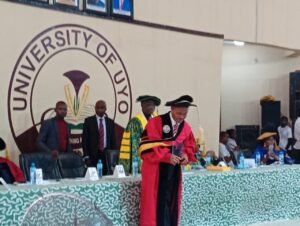
UNIUYO Hosts 127th Inaugural Lecture, Calls for Professionalism as Catalyst for National Development
The University of Uyo (UNIUYO), Akwa Ibom State on Thursday, February 19, 2026, held its 127th Inaugural Lecture with a strong call for professionalism across all sectors as the surest path to Nigeria’s meaningful development.
Delivering the lecture titled “Professionalism”, Professor Nsikan Senam, a Professor of Media Law, Ethics and Strategic Communication, underscored the centrality of competence, integrity and ethical conduct in nation-building, warning that mediocrity in public life continues to undermine the country’s progress.
The event, which commenced with the rendition of the National Anthem and the University Anthem, drew academics, legal practitioners, media professionals, students and dignitaries from across the state.
In his lecture, Prof. Senam described professionalism as “the nucleus of competence and ethical standpoint in every human endeavour,” stressing that it cuts across all works of life and occupations.
He traced his personal and professional journey through law, broadcasting, cinematography, sports journalism and teaching, noting that his experiences shaped his commitment to professional standards.
According to him, professionalism is characterised by competence, integrity, diligence, dedication, emotional stability, respect for others’ views, commitment to excellence and passion.
“Nigeria would only experience meaningful development when there is commendable regard for professionalism,” he declared.
The professor explored the intricate relationship between law, government and the media, describing it as a “marriage of convenience.”
He explained that while government enacts and amends laws regulating media practice, the media in turn plays a crucial role in surveillance, agenda-setting, social integration and status conferral in society.
Prof. Senam examined major schools of jurisprudence: Natural, Positive, Realist, Sociological, Historical and Utilitarian noting that, no society operates exclusively on the tenets of a single school.
He referenced landmark cases such as Bello v. A.G. of Oyo State (1986) and Shitta-Bey v. Federal Civil Service Commission (1981) to illustrate the application of judicial precedent and the role of judicial review in Nigeria’s legal system.
On media law, he highlighted critical issues including defamation, sedition, obscenity, privacy and copyright, stressing that mass media practice must operate within established legal and ethical boundaries.
Prof. Senam warned that journalism practice faces pressures from commercialism, socio-political dependence and cultural influences, which have contributed to declining standards in some quarters.
He emphasised truthfulness, accuracy, fairness, objectivity and editorial independence as core ethical pillars necessary to sustain media credibility.
According to him, “Mass media credibility is the ability to gain acceptance and confidence of the audience through trustworthy and believable contents”.
He further addressed ethical dilemmas such as; deception, conflict of interest, plagiarism, media manipulation and sycophancy, urging practitioners to adhere strictly to professional codes.
In a bold recommendation, the professor called on the National Assembly to amend the 1999 Constitution to require that anyone seeking to contest for the office of President must be a graduate or a respected professional before qualifying for election.
“How can the Constitution of a nation celebrate mediocrity to the extent of allowing a would-be President in the 21st Century qualify to stand election and assume office without a certificate?” he queried.
He also urged professional bodies to intensify efforts to eliminate quackery and sharp practices within their respective fields.
Drawing from biblical references in Romans 12:18 and Ecclesiastes 12:13, Prof. Senam urged Nigerians to live peaceably and uphold moral principles in both public and private life.
He expressed gratitude to UNIUYO for the opportunity to serve and for his elevation to the rank of Professor, thanking the Vice Chancellor, management and audience for their support and attentiveness.
The 127th Inaugural Lecture ended with a resounding affirmation that professionalism remains indispensable to justice, equity, media credibility and sustainable national development.
