

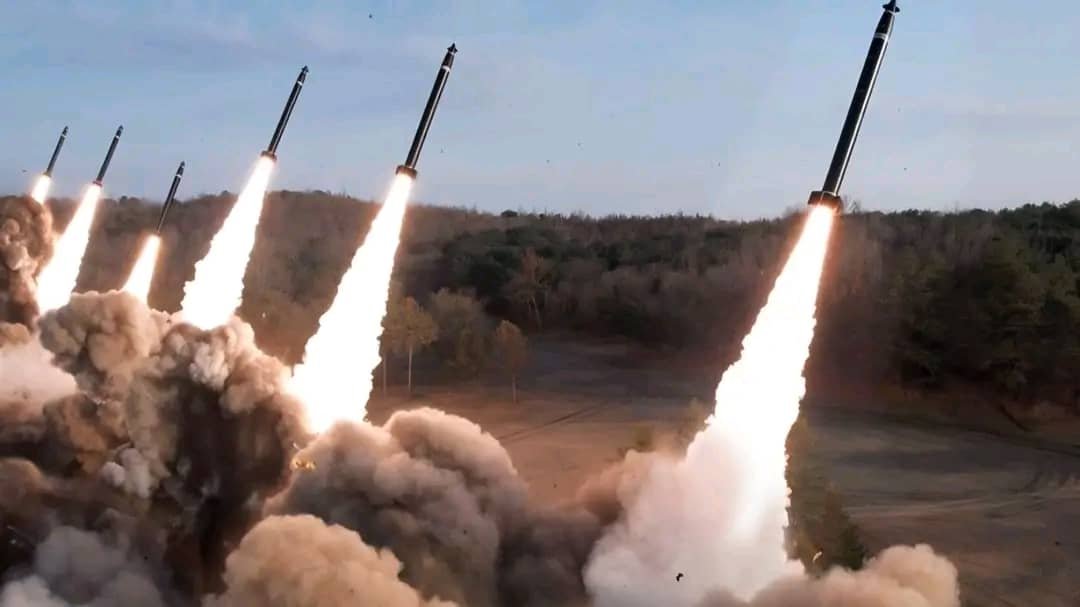
North Korea has fired several ballistic missiles toward the East Sea, also known as the Sea of Japan, in a fresh show of military force that comes amid rising tensions with South Korea over a recent landmine explosion along their heavily fortified border.
The missile launches, which were detected on Sunday morning, have further heightened security concerns on the Korean Peninsula, where relations between Pyongyang and Seoul have deteriorated sharply in recent weeks.
South Korea’s Joint Chiefs of Staff, JCS, confirmed the development in a statement issued today, saying the launches were detected at about 9:20 a.m. local time from the Pyongyang area.
According to the JCS, several ballistic missiles were fired from the vicinity of the North Korean capital and flew toward the East Sea, with some of the projectiles covering a considerable distance before landing in the waters.
South Korean military authorities disclosed that some of the missiles fired by the North travelled more than 900 kilometres, indicating a significant range capability and raising concerns about the nature of the weapons tested.
The military said it is working closely with the United States to conduct a detailed analysis of the missiles, including their flight distance, altitude, speed and other technical specifications, to determine the exact type of ballistic missiles launched.
The JCS noted that the South Korean military has strengthened surveillance and vigilance following the launches and is maintaining a full readiness posture in close coordination with its American allies.
The latest missile firings come at a time of heightened tension between the two Koreas, following a joint investigation that blamed North Korea for landmines that exploded in the Demilitarized Zone, DMZ, and injured three South Korean soldiers.
The landmine explosion, which occurred along the heavily fortified inter-Korean border, had prompted a strong reaction from Seoul, which accused Pyongyang of deliberately planting the mines in violation of existing inter-Korean agreements.
According to South Korean authorities, the joint investigation found that the mines that injured the soldiers were of North Korean origin and had been recently laid in the DMZ, a buffer zone that separates the two countries and is one of the most heavily mined areas in the world.
However, North Korea has denied responsibility for the landmine incident, rejecting the findings of the investigation and accusing South Korea of fabricating the incident to justify heightened military activity and anti-North propaganda.
Pyongyang’s denial has further deepened mistrust between the two sides, with Seoul insisting that it has clear evidence linking the North to the explosion, while the North has maintained that it has no connection to the incident.
The missile launches are seen by analysts as a response to the accusations from Seoul and as part of North Korea’s continued demonstration of its military capabilities amid stalled denuclearisation talks and increased military cooperation between South Korea and the United States.
Security experts believe that North Korea often uses missile tests to send political signals to its neighbours and to the international community, particularly when tensions rise or when it feels pressured by joint military drills between Seoul and Washington.
Sunday’s launches mark the latest in a series of missile tests conducted by North Korea this year, as the reclusive state continues to advance its ballistic missile programme despite international sanctions and condemnation from the United Nations.
The East Sea, where the missiles landed, has been a frequent destination for North Korean missile tests, with Pyongyang regularly firing short-range and medium-range ballistic missiles into the waters as part of its weapons development programme.
The international community has repeatedly condemned North Korea’s ballistic missile launches, describing them as violations of United Nations Security Council resolutions that prohibit the North from conducting any tests using ballistic missile technology.
South Korea’s presidential office is said to be closely monitoring the situation and has convened security meetings to assess the implications of the latest launches and the rising tensions along the border.
The United States has also been notified of the launches, and American and South Korean intelligence authorities are said to be sharing information and conducting a comprehensive analysis of the missiles to determine whether they represent a new capability.
Meanwhile, there are concerns that the exchange of accusations over the landmine explosion and the subsequent missile launches could lead to further escalation, with calls for restraint from regional powers and the international community.
Observers have urged both Koreas to avoid actions that could further heighten tensions and to seek dialogue to prevent any miscalculation that could lead to a larger confrontation on the peninsula.
The Demilitarized Zone, which stretches for about 250 kilometres across the Korean Peninsula, remains one of the most tense and heavily armed borders in the world, with both sides maintaining large numbers of troops and heavy weaponry along the frontier.
Despite the current tensions, South Korea has reiterated its commitment to maintaining a strong defence posture while keeping the door open for dialogue, emphasising that it will respond firmly to any provocation from the North.
As of the time of filing this report, North Korea’s state media has not provided details on Sunday’s missile launches, but previous launches have often been celebrated by Pyongyang as successful tests of its strategic deterrence capabilities.