
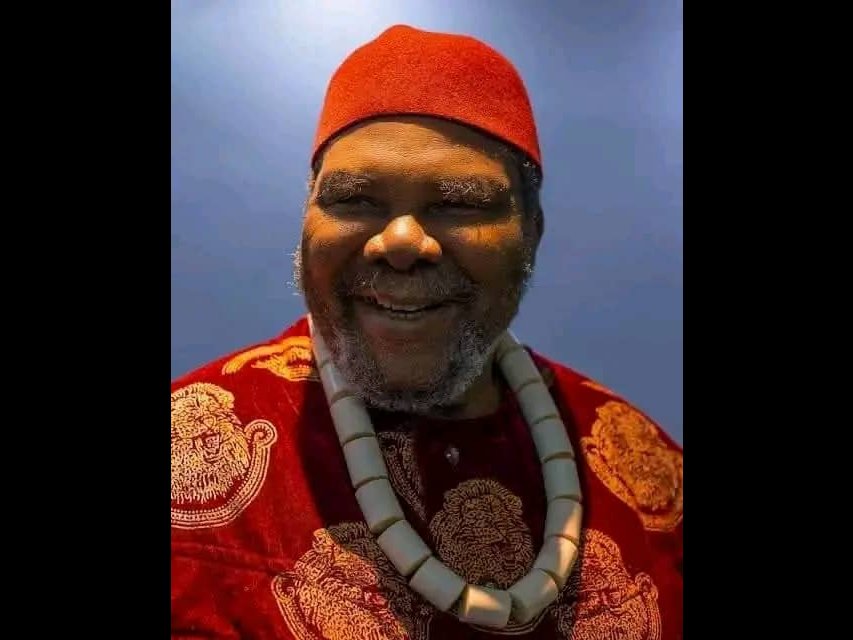
Nollywood has been thrown into deep mourning following the death of one of its finest, most respected and most iconic figures, veteran actor Chief Dr. Pete Edochie, MON, who passed away in the early hours of Wednesday, 25th November, 2026, in Enugu, after a long and courageous battle with prostate cancer, at the age of 79.
The sad news was announced in a family statement released on Wednesday morning by his son, Leo Pete Edochie, on behalf of the entire family, a statement titled “An Iroko Has Fallen”, which confirmed that the legendary actor breathed his last at 12:30 a.m. in Enugu, bringing to an end a life that was defined by excellence, discipline, dignity and an uncommon commitment to the promotion of African culture.
The statement read, “With profound sadness and hearts bowed in total submission to the will of Almighty God, we announce the passing of our beloved husband, father, brother and kinsman, Chief Dr. Pete Edochie, MON (Ononenyi), a retired broadcaster and veteran actor, who departed this life on Wednesday, 25th November, 2026 at 12:30 a.m. after a protracted battle with prostate cancer in Enugu, Nigeria. He was aged 79 years.” 94fb
The family further disclosed that Chief Edochie hailed from Akamnato Ifite Nteje in Anambra State, and is survived by his beloved wife, Barrister Mrs. Josephine Edochie, his children, siblings and numerous other relations, while adding that funeral arrangements would be communicated at a later date, as the family takes time to grieve and to plan a befitting farewell for the icon.
The death of Pete Edochie, who died at 12:30am on Wednesday, November 25, 2026, in Enugu, after a prolonged battle with prostate cancer, according to the family statement, has sent shockwaves across Nigeria and beyond, with tributes pouring in from fellow actors, politicians, traditional rulers, fans and lovers of African cinema, who described him as irreplaceable. 94fb
Born on 7th March, 1947, in Zaria, Kaduna State, where his father was working at the time, Pete Edochie grew up in a disciplined home, attended St. Patrick’s and St. James Primary School, Zaria, before proceeding to St. John’s College, Kaduna, for his secondary education, where his leadership qualities and his love for the arts began to manifest at an early age.
After his secondary education, he joined the Eastern Nigeria Broadcasting Corporation, ENBC, in 1967, at the age of 20, as a junior programmes assistant, and rose through the ranks, through hard work, dedication and professionalism, to become a Director of Programmes, and later the Deputy Managing Director, before he was forced to leave the corporation, following the decision of the government to politicise the affairs of the station.
It was while he was at the ENBC that Pete Edochie honed his skills in broadcasting, presentation, production and acting, and became a household name in the old Eastern Region, through his distinctive voice, his command of the English language, and his ability to interpret roles with depth, emotion and authenticity, qualities that would later define his career in Nollywood.
His life changed forever in 1987, when he was cast to play the lead role of Okonkwo in the Nigerian Television Authority, NTA, adaptation of Chinua Achebe’s world-renowned novel, Things Fall Apart, a role that catapulted him to national and international fame, and that established him as one of Nigeria’s most celebrated performers. ce17
His portrayal of Okonkwo, the strong-willed, proud and tragic hero of Umuofia, was so powerful, so convincing and so memorable, that it remains, till today, one of the greatest performances in the history of African television, and it earned him the admiration of Chinua Achebe himself, who reportedly described him as the perfect interpreter of his character.
From that moment, Pete Edochie became the face of Nollywood, starring in over 300 films, including Living in Bondage, Narrow Escape, Rituals, Igodo, Last Burial, Billionaire’s Club, Evil Men, Lion of Africa, Egg of Life, and many others, in which he mostly played the roles of kings, chiefs, traditional rulers, family patriarchs and village elders, roles he played with uncommon royalty, wisdom and authority.
He was celebrated for his commanding screen presence, distinctive voice, rich repertoire of African proverbs and portrayal of traditional rulers and family patriarchs, qualities that made him stand out among his peers, and that made producers and directors always run to him whenever they needed a character that would command respect and attention. 1cea
Beyond acting, Pete Edochie was a philosopher, a cultural ambassador, and a moral voice, whose interviews, speeches and social media videos were filled with wisdom, proverbs, and lessons on life, marriage, family, respect, hard work and the dignity of the African man, and who was fondly called “Ebubedike” and “Ononenyi” by his fans, titles that reflected his towering personality.
He was also known for his strong stance on African values, his defence of the Igbo culture, his belief in the sanctity of marriage, and his refusal to compromise his principles for fame or money, a stance that earned him the respect of millions of Nigerians, including the younger generation, who saw him as a father, a mentor and a role model.
In recognition of his immense contributions to the growth of the Nigerian film industry and to national development, the Federal Government of Nigeria honoured him with the national honour of Member of the Order of the Niger, MON, in 2003, by former President Olusegun Obasanjo, alongside other distinguished Nigerians, an honour he cherished till his death.
He was also honoured with numerous awards, including the Lifetime Achievement Award at the Africa Movie Academy Awards, the Best Actor in a Leading Role at various film festivals, and honorary doctorate degrees from several universities, in recognition of his contributions to the arts, culture and education in Nigeria and Africa.
Pete Edochie was married for over 57 years to his beloved wife, Barrister Josephine Edochie, a marriage that was celebrated as one of the most stable and exemplary in Nollywood, and which produced six children, including Yul Edochie, the popular Nollywood actor and filmmaker, Linc Edochie, Leo Edochie, and others, who have continued to uphold the legacy of their father in the entertainment industry.
Despite his fame and fortune, he remained humble, disciplined and down-to-earth, living a simple life in Enugu, where he was loved and respected by his neighbours, his kinsmen, and the entire community, and where he was always willing to offer advice, support and encouragement to young people who came to him for guidance.
His health challenges became public knowledge in recent years, following reports that he was battling prostate cancer, a disease that he fought with courage, faith and dignity, and for which he received treatment in Nigeria and abroad, while his family kept details of his health condition private, to allow him to recover in peace, away from the prying eyes of the public.
Wednesday’s announcement came nine months after his family dismissed rumours of his death in February 2026, when false reports of his death went viral on social media, forcing the family to issue a statement to debunk the rumour, and to assure the public that he was alive and well, a development that makes his actual death even more painful for his fans, who had prayed for his recovery. ce17
Since the news of his death broke on Wednesday morning, tributes have continued to pour in from all walks of life, with President Bola Ahmed Tinubu, Governors, Senators, fellow actors, musicians, and fans describing him as a colossus, a legend, a cultural icon, and a man whose death has created a vacuum that will be difficult to fill in Nollywood and in Nigeria as a whole.
The Actors Guild of Nigeria, AGN, in a statement, described his death as a monumental loss to the Nigerian film industry, and said the industry has lost a father, a teacher, and a pillar, whose contributions to the growth of Nollywood will never be forgotten, and whose legacy will continue to inspire generations of actors yet unborn.
His son, Yul Edochie, in an emotional tribute, described his father as the greatest actor of all time, a man who taught him everything about acting, about life, and about being a man, and who will be greatly missed, while other children of the late actor also paid glowing tributes to their father, describing him as a loving, caring and disciplined father.
In his hometown of Nteje in Anambra State, the mood was sombre on Wednesday, as residents, traditional rulers, and community leaders gathered to mourn the loss of their illustrious son, describing him as a proud son of Nteje, who never forgot his roots, and who used his fame to promote the culture and traditions of his people, and to attract development to his community.
In Enugu, where he lived for many years, and where he died, residents also mourned his passing, with many of them visiting his residence to commiserate with his family, and to pay their last respects to a man they described as a neighbour, a friend, and a father to all, who was always ready to help those in need.
As Nollywood mourns the loss of one of its brightest stars, there is also a renewed call for the Federal Government, the Anambra State Government, and the Nigerian film industry to immortalise Pete Edochie, by naming a film institute, a cultural centre, or a street after him, and by preserving his films, his interviews, and his wise sayings, for future generations to learn from.
For now, the family has said funeral arrangements would be communicated at a later date, without giving details of when or where he would be laid to rest, as they take time to mourn, to consult with elders, and to plan a befitting burial for a man who was not just an actor, but a king, a philosopher, and an Iroko tree, whose fall has shaken the entire forest of Nollywood.
Pete Edochie is survived by his wife, children, grandchildren, siblings and numerous relations, and though he is gone, his voice, his proverbs, his films, and his wisdom will continue to live on in the hearts of millions of Nigerians, and in the annals of African cinema, where his name will forever be written in gold, as one of the greatest actors Africa has ever produced.