

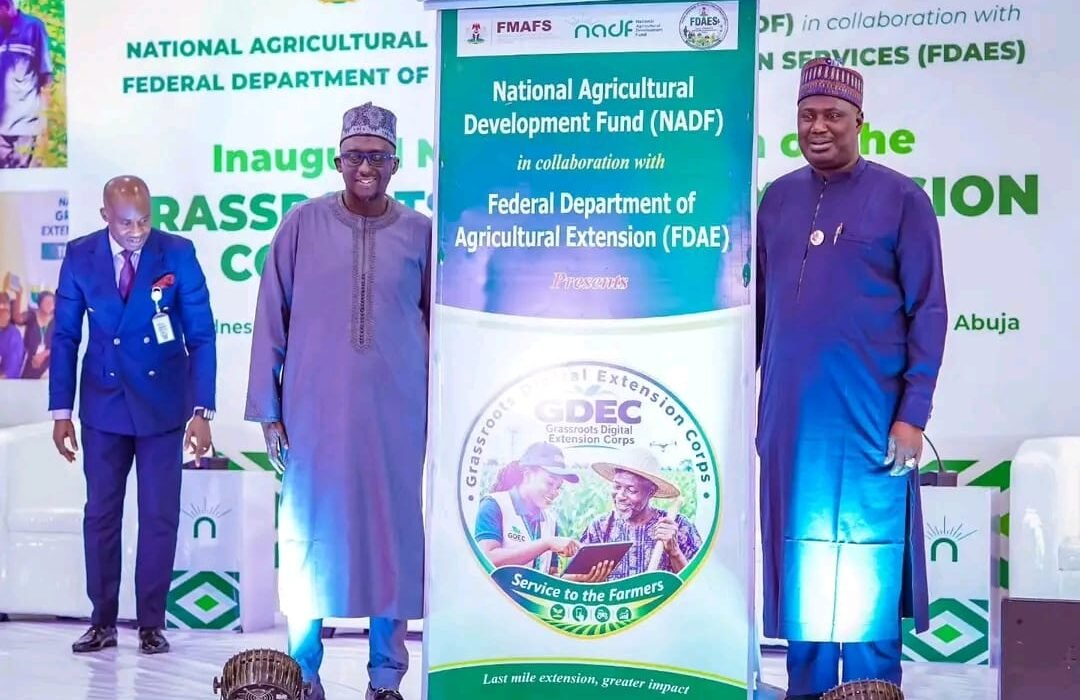
The Federal Government of Nigeria has successfully trained a total of One Thousand Eight Hundred and Eighty-Four agricultural extension agents and food security specialists across the country under a new digital initiative aimed at improving farmers’ access to modern agricultural knowledge, best practices and innovative technologies to strengthen national food security and increase productivity.
The training, which was conducted under the Grassroots Digital Extension Corps programme, was initiated, funded and implemented by the National Agricultural Development Fund, NADF, in collaboration with relevant agricultural institutions, research centres and development partners, as part of efforts to revitalise the agricultural extension system in Nigeria.
Speaking at the official launch and graduation ceremony of the programme in Abuja on Wednesday, the Minister of State for Agriculture and Food Security, Senator Aliyu Sabi Abdullahi, said the initiative is a strategic intervention that will significantly improve farm productivity, enhance farmers’ knowledge and support the full realisation of Nigeria’s huge agricultural potential.
Senator Abdullahi, who represented the Federal Government at the event, explained that the programme is designed to bridge the knowledge gap between agricultural researchers, scientists and farmers at the grassroots level, by deploying digitally-equipped extension agents who will provide timely, accurate and relevant agricultural information, advisory services and technical support to farmers.
According to the Minister, the initiative is in line with President Bola Ahmed Tinubu’s Renewed Hope Agenda, which places high premium on food security, agricultural transformation, rural development and economic diversification, noting that without effective extension services, farmers cannot benefit from modern research findings, improved seeds and climate-smart agricultural practices.
He lamented that over the years, the agricultural extension system in Nigeria had suffered neglect, underfunding and manpower shortage, with the ratio of extension agents to farmers becoming unacceptably low, thereby leaving millions of smallholder farmers without access to critical information, inputs and advisory services that could have helped them to increase their yields and incomes.
Senator Abdullahi said with the training and deployment of 1,884 extension agents and food security specialists, the Federal Government is taking a bold step towards reversing the trend, rebuilding the extension architecture and ensuring that farmers in all parts of the country have access to modern agricultural knowledge, market information and innovative solutions to farming challenges.
He noted that the extension agents have been equipped with digital tools, mobile applications, tablets and other modern gadgets that will enable them to collect data, disseminate information, diagnose farm problems, provide real-time advisory services and connect farmers to input suppliers, off-takers, financial institutions and other actors in the agricultural value chain.
The Minister expressed optimism that the deployment of the trained personnel will lead to increased farm productivity, reduced post-harvest losses, improved adoption of improved seeds and technologies, better farming practices, increased incomes for farmers and ultimately enhanced food security, availability and affordability of food items for all Nigerians.
In his remarks at the event, the Executive Secretary of the National Agricultural Development Fund, Mr. Mohammed Ibrahim, said the Grassroots Digital Extension Corps programme is not just about training numbers but about impact, results and tangible benefits for Nigerian farmers, stressing that the programme will be assessed by its impact on the ground.
Mr. Ibrahim said the success of the programme will be measured by key performance indicators such as the number of farmers reached, the number of farming communities covered, the improvement in crop yields, reduction in post-harvest losses, increased adoption of modern farming techniques and overall improvement in productivity, food security and rural livelihoods.
He explained that out of the total number of personnel trained, One Thousand One Hundred and Ten are agricultural extension agents who will be deployed to work directly with farmers in rural communities, while Seven Hundred and Seventy-Four are food security specialists who will focus on issues such as food preservation, storage, nutrition, value addition and reduction of food wastage.
The NADF boss noted that the selection of the trainees was done through a rigorous, transparent and merit-based process that cut across all 36 states of the federation and the Federal Capital Territory, with emphasis on competence, passion for agriculture, familiarity with local languages and cultures and willingness to work and live in rural communities where their services are most needed.
He said the training curriculum was comprehensive, intensive and practical-oriented, covering areas such as modern crop production techniques, livestock management, climate-smart agriculture, soil health management, pest and disease control, digital agriculture, use of mobile technology for extension, data collection, communication skills and community engagement strategies.
According to him, the trainees were also exposed to modern extension methodologies, adult education techniques, gender mainstreaming in agriculture, youth engagement, financial literacy, agribusiness development and other relevant skills that will enable them to effectively serve as change agents, knowledge brokers and development facilitators in their respective communities.
Mr. Ibrahim thanked the Federal Ministry of Agriculture and Food Security, the Agricultural Research Council of Nigeria, the National Agricultural Extension and Research Liaison Services and other collaborating institutions for their support, partnership and technical assistance in ensuring the successful implementation of the programme from conception to completion.
He assured Nigerians that the National Agricultural Development Fund will continue to monitor, supervise and evaluate the activities of the extension agents and food security specialists after deployment, to ensure that they deliver on their mandate, remain committed to their duties and provide quality services to farmers, while also ensuring accountability and transparency in the management of the programme.
Speaking on behalf of the trainees, some of the beneficiaries expressed gratitude to the Federal Government and the NADF for the opportunity, training and empowerment, promising to justify the confidence reposed in them by working diligently, selflessly and passionately to support farmers, improve productivity and contribute to the achievement of food security in Nigeria.
They said the training has equipped them with modern knowledge, digital skills and practical experience that will enable them to make a real difference in the lives of farmers, adding that they are ready, willing and eager to be deployed to their respective duty posts to commence work immediately and to serve as ambassadors of agricultural transformation in their communities.
Meanwhile, stakeholders in the agricultural sector have welcomed the initiative, describing it as a timely, laudable and strategic intervention that will help to address the extension gap, boost food production and create jobs for youths, while calling on the Federal Government to ensure sustainability, adequate funding and regular retraining of the extension agents to keep them abreast of emerging trends in global agriculture.