
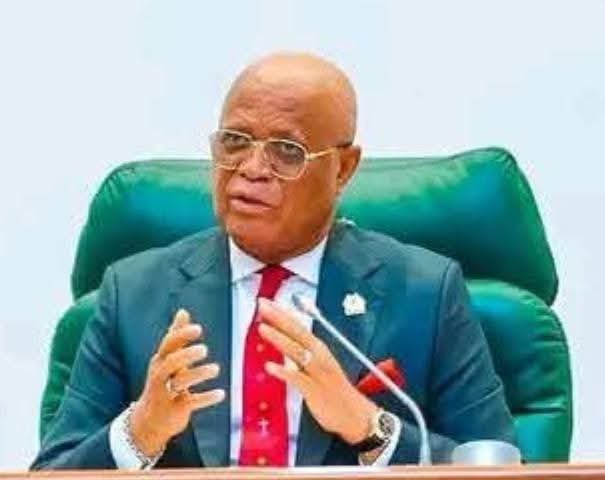
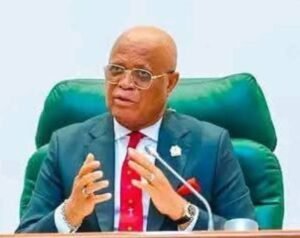
UYO – Governor Umo Eno of Akwa Ibom State has formally entered the race for a second term, framing his re-election bid less as a ‘political ambition’ and more as a ‘plea for continuity’ in a state increasingly defined by long-cycle infrastructure projects and ambitious public spending.
Returning from Abuja after submitting his nomination form for the All Progressives Congress (APC) governorship primaries, Governor Eno argued that, many of the projects initiated under his administration remain unfinished and require sustained leadership to achieve their intended economic impact.
The governor’s message reflects a familiar calculation, where the incumbents often present continuity as a safeguard against abandoned projects, policy reversals and bureaucratic disruption.
In Akwa Ibom, where large-scale investments in roads, aviation, tourism and rural development have become central to the administration’s ARISE Agenda, the governor appears determined to make projects completion the central argument of his re-election campaign.
“There is still so much work on ground,” the governor said, noting that several flagship projects would extend beyond the lifespan of his current mandate. He maintained that, the original “visioner” of the initiatives was best positioned to deliver them according to plan.
Behind the rhetoric lies a broader political strategy. By tying his candidacy to continuity rather than personality, Governor Eno is seeking to convert governance into electoral capital at a time, when many Nigerian governors face increasing scrutiny over rising public expectations and economic hardship.
Akwa Ibom has in recent years pursued an aggressive development agenda, including aviation expansion, marine transport revival and infrastructure renewal aimed at strengthening the state’s non-oil economy.
Supporters of the administration argue that policy consistency is necessary if those investments are to yield measurable returns.
Critics, however, may question whether continuity alone guarantees development outcomes in a country, where grand projects often struggle with execution, transparency and long-term sustainability.
Still, with the APC primaries approaching, the governor’s early declaration signals confidence in both his political standing and the appeal of his development narrative.
For now, the governor is wagering that voters will see unfinished projects not as evidence of incomplete governance, but as reason to extend his tenure.