
Abuja — President Bola Ahmed Tinubu on Tuesday declared that Nigeria has overcome the worst of its security and economic challenges, assuring citizens that prosperity is within reach as ongoing reforms continue to strengthen national stability.
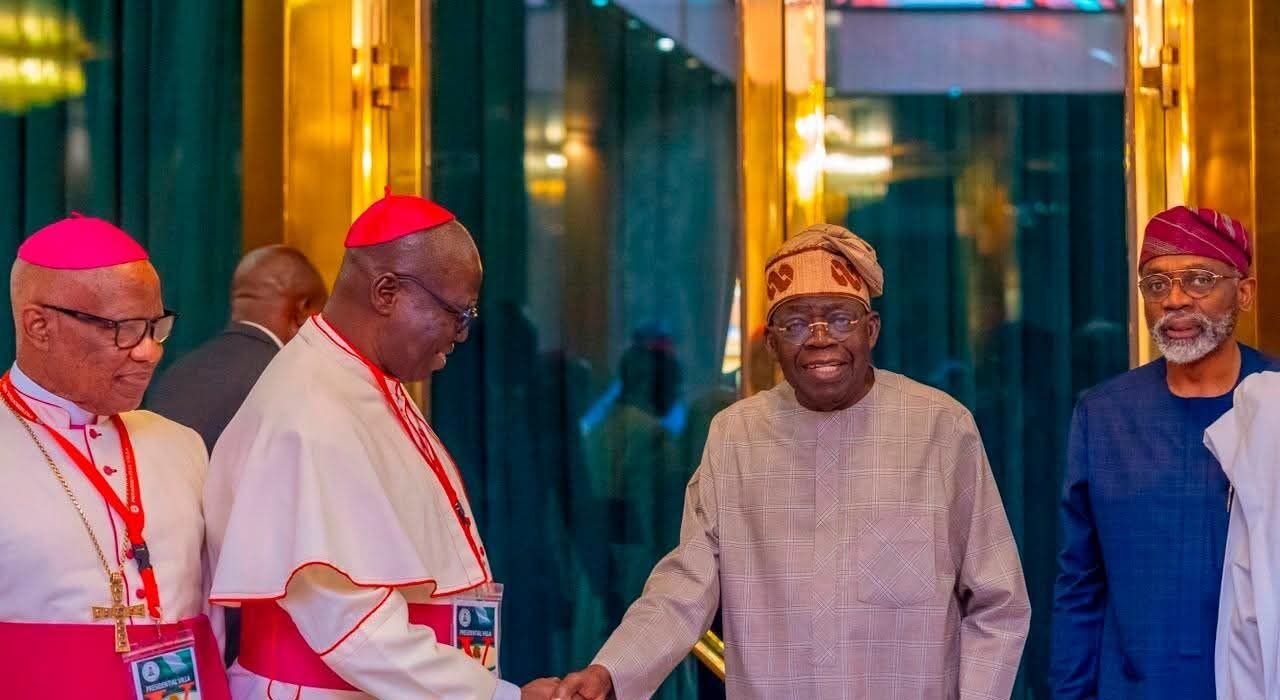
Speaking while receiving the leadership of the Catholic Bishops’ Conference of Nigeria (CBCN) at the Presidential Villa, Abuja, the President expressed confidence that the restructuring of the nation’s security architecture would soon yield decisive victories against terrorism, banditry and kidnapping.
The delegation, led by CBCN President and Archbishop of Kaduna, Most Rev. Matthew Ndagoso, included 19 senior Catholic clerics, among them Cardinals John Onaiyekan and Peter Okpaleke, as well as the Bishop of Sokoto Diocese, Matthew Kukah.
Tinubu disclosed that his administration had approved the expansion of the Armed Forces and was investing substantially in military hardware, intelligence gathering, troop welfare and operational logistics to enhance the fight against insecurity.
“We will defeat terrorism,” the President said, calling on religious leaders to support government efforts by promoting peace, unity and tolerance.
“We do not have another country but Nigeria. In our diversity and complexity, we shall thrive, live and rejoice together,” he added.
On the economy, Tinubu maintained that the reforms initiated by his administration had pulled Nigeria away from the brink of fiscal crisis and laid a solid foundation for sustainable growth and development.
According to him, economic indicators now point to recovery and renewed confidence.
“The country has been placed on a sound footing. The economy has recovered. The alarm of bankruptcy and the dark tunnel of uncertainty we met on assumption of office have been reversed,” he stated.
“This government has stabilised the nation, and prosperity is on the horizon. Life is improving.”
The President cited the Nigerian Education Loan Fund (NELFUND) as one of the flagship programmes designed to expand access to higher education and reduce poverty, stressing that education remains a critical instrument for national development.
Tinubu also pointed to the relative stability in the university system, noting that the era of prolonged strikes by the Academic Staff Union of Universities (ASUU) had largely been brought under control.
“You can’t say a four-year university course is not four years now. ASUU is not on strike and is no longer bringing agony to our homes. For me, that is an answered prayer,” he said.
Addressing political concerns ahead of the 2027 general elections, the President dismissed allegations of bias against the Independent National Electoral Commission (INEC), insisting that the electoral body remained neutral and committed to providing equal opportunities for all political parties.
“The opportunities are equal. INEC is neutral and has never intimidated anyone. If political opponents are crying wolf, perhaps they are afraid of their own shadows,” Tinubu remarked.
He further reiterated his commitment to education and mission schools, recalling that his administration in Lagos State returned several mission schools to their original proprietors. He noted, however, that decisions on such matters now rest with individual state governments under the Constitution.
Earlier, Archbishop Ndagoso commended the cordial relationship between Nigeria and the Vatican, particularly following the recent celebration of 50 years of diplomatic relations between both entities.
The cleric, however, expressed concerns over lingering insecurity, poverty, access to quality tertiary education and the need to deepen democratic governance.
He urged the President to guarantee credible, transparent and peaceful elections in 2027, stressing that strengthening democratic institutions would remain a defining legacy of Tinubu’s administration.
“As a man who sacrificed much in the struggle for the restoration of democracy, your greatest legacy would be the strengthening of democratic institutions,” Ndagoso said.
The meeting highlighted continued collaboration between the Federal Government and religious leaders on critical national issues, including security, governance, education and social welfare, as both sides pledged support for efforts aimed at fostering peace and national developments.