

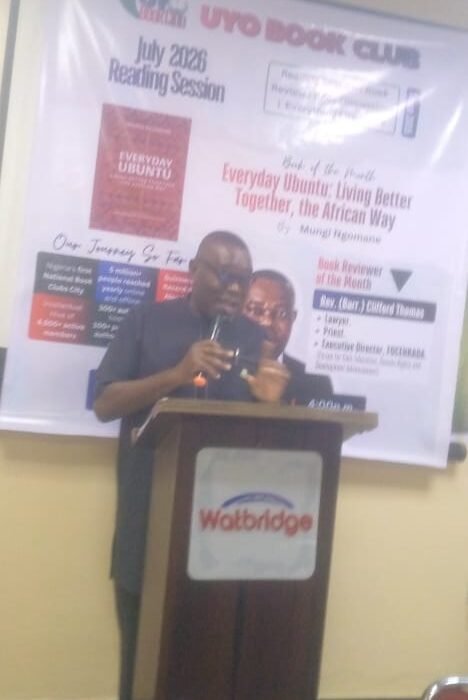
 UYO – Participants at the July Reading Session of the Uyo Book Club (UBC) have called on Nigerians to embrace the African philosophy of Ubuntu, a culture of communal living, love, unity and collective responsibility as a pathway to addressing the country’s growing insecurity and strengthening national cohesion.
The call was made during a review of the book, Everyday Ubuntu: Better Together, the African Way, authored by South African writer Mungi Ngomane, at a gathering held in Uyo, the Akwa Ibom State capital.
Reviewing the book, the Executive Director of the Forum for Civic Education, Human Rights and Development Advancement (FOGHRADA), Barr. Clifford Thomas, described Ubuntu as a timeless African philosophy that promotes shared humanity and communal responsibility.
According to him, many of Nigeria’s social and security challenges stem from the gradual abandonment of traditional African values of brotherhood, selflessness and collective welfare.
“Ubuntu teaches that what affects one person affects the entire community. If Nigerians can return to the culture of love, unity and being one another’s keeper, insecurity and social dislocation would be significantly reduced,” he said.
Thomas noted that the philosophy cuts across political, social and cultural spheres of life, stressing that it encourages citizens to place community interests above personal gain.
He argued that the rise of excessive individualism and materialism had weakened the communal bonds that once defined African societies, creating fertile ground for insecurity, ethnic divisions and social inequality.
The reviewer further maintained that capitalism, as practised in many developing countries, contradicts the Ubuntu ideal of collective ownership, community development and shared prosperity.
He lamented what he described as the consequences of excessive borrowing and economic dependence, urging leaders to prioritise the prudent management of Nigeria’s abundant resources for the benefit of the people.
Thomas also linked the absence of Ubuntu values to the persistence of ethnic tensions, selfishness and the concentration of wealth in the hands of a few individuals.
He advocated true federalism, resource control and citizen welfare as essential elements of nation-building that align with the Ubuntu philosophy.
“We must return to the old values of love, unity and togetherness if we are to build a better society. When people genuinely care for one another, development becomes inclusive and sustainable,” he added.
In a goodwill message from South Africa, Clarence Kwinana commended the Uyo Book Club for selecting a book that reflects African humanism and solidarity.
Kwinana, who identified himself as a member of the Xhosa ethnic group from South Africa’s Eastern Cape Province, said, Ubuntu remains a central aspect of his culture and praised the late Archbishop Desmond Tutu, grandfather of the author, for championing humanity, justice and social cohesion throughout his life.
He expressed optimism that the discussions generated by the book would help deepen conversations on African values and collective progress.
Founder of the Uyo Book Club, Dr Udeme Nana, urged Nigerians to cultivate a strong reading culture, noting that books remain powerful tools for social transformation and intellectual development.
He commended Barr. Thomas for his insightful review and for successfully relating the book’s themes to contemporary realities in Nigeria and across Africa.
The session also featured the unveiling of a sticker bearing the inscription, “Don’t Be a Digidiot,” a term coined by Dr Nana and recently included in the Advanced Learners Dictionary of Modern English, aimed at promoting responsible use of digital technology.
The event attracted book enthusiasts, academics, civil society advocates and lovers of African literature, who engaged in discussions on the relevance of Ubuntu to modern governance and nation-building.