

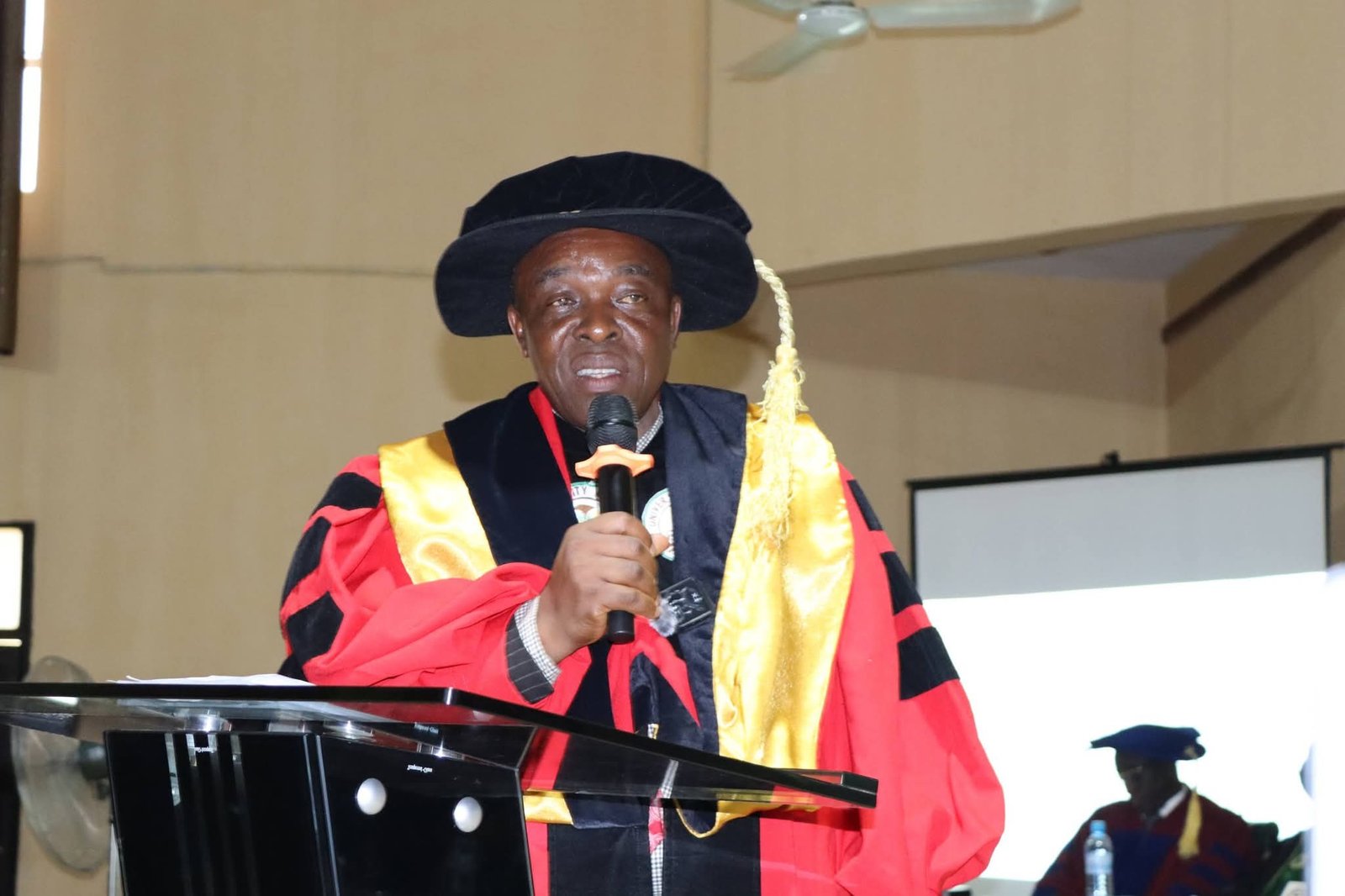
UYO – A Professor of Criminology at the University of Uyo, Ebere James Okorie, has described corruption in Nigeria as a deeply entrenched institutional disease that has weakened governance, fuelled insecurity, hindered development, and eroded public trust in public institutions.
Professor Okorie made the declaration while delivering the 137th Inaugural Lecture of the University of Uyo, titled “Institutional Corruption in Nigeria: Diagnosis, Lessons and the Way Forward,” at the weekend.
In a comprehensive analysis of Nigeria’s governance challenges, the scholar argued that corruption in the country has evolved beyond isolated acts of misconduct into a systemic and institutionalized phenomenon embeded in the nation’s political, economic, judicial, security, educational, and administrative structures.
Using medical metaphors to illustrate the gravity of the situation, Okorie said Nigeria requires both a “stethoscope and microscope” to properly diagnose and treat the menace of corruption.
He described the nation as a patient suffering from “social cancer” and “social HIV/AIDS,” allegedly inflicted by corruption, prebendal politics, and what he termed “Iberiberism” — a culture of manipulation, confusion, and self-destructive governance practices.
According to him, corruption thrives not because Nigerians are naturally unethical, but because existing institutional arrangements reward corrupt behaviour while punishing integrity and accountability.
The professor identified political interference, weak accountability mechanisms, judicial delays, selective prosecution, poor whistleblower protection, and the erosion of meritocracy as major drivers of institutional corruption in Nigeria.
He lamented that public offices have increasingly become avenues for personal enrichment, ethnic patronage, and political loyalty rather than platforms for public service.
“Corruption does not merely coexist with crime; it actively produces crime by weakening law enforcement, distorting justice delivery, eroding deterrence mechanisms and legitimising impunity,” he stated.
The inaugural lecturer further linked Nigeria’s persistent insecurity including terrorism, banditry, kidnapping, oil theft, cybercrime, and electoral violence to institutional decay and corruption within security agencies.
According to him, compromised security institutions, poor intelligence systems, and corruption in procurement processes have significantly undermined national security efforts.
Professor Okorie also criticized the country’s judicial system, describing it as increasingly vulnerable to political interference, prolonged delays, and allegations of “cash-and-carry justice.” He noted that some legal disputes linger in courts for decades, thereby weakening public confidence in the rule of law.
On the economic front, the criminologist maintained that corruption remains one of the greatest obstacles to national development, arguing that Nigeria’s underdevelopment is not due to a lack of resources but the systematic distortion of institutions.
He observed that funds meant for infrastructure, healthcare, education, and security are often diverted into private hands, while investors are discouraged by bribery, regulatory capture, and policy inconsistencies or summersault.
The professor further warned that corruption within universities and political institutions poses a grave threat to Nigeria’s future, as both sectors are responsible for producing ethical leaders, knowledge, and public values.
He decried practices such as admission racketeering, academic fraud, political patronage, and the commercialization of public offices, saying they have weakened institutional credibility and national progress.
To illustrate the state of public institutions, Okorie employed the metaphor of “Rotten Eggs and Decorated Graves,” explaining that many Nigerian institutions appear functional on the surface but are internally weakened by corruption, inefficiency, and ethical decay.
Despite the bleak diagnosis, the scholar expressed optimism that Nigeria could overcome its governance challenges through deliberate reforms.
He recommended comprehensive institutional restructuring, transparency in public administration, digital governance systems, merit-based appointments, stronger anti-corruption agencies, judicial reforms, ethical leadership, and enhanced accountability mechanisms.
Professor Okorie also called on academics to assume greater responsibility as institutional critics, policy architects, ethical leaders, and public intellectuals capable of driving societal transformation.
He concluded that sustainable national development can only be achieved through the building of strong, transparent, accountable, and effective institutions.
“Development is not something a nation buys with loans; it is something it builds through robust institutions,” he emphasized.
The lecture attracted members of the university community, government officials, security experts, academics, students, and distinguished guests who gathered to reflect on one of Nigeria’s most persistent governance challenges and the pathways toward institutional rebirth and national renewal.